
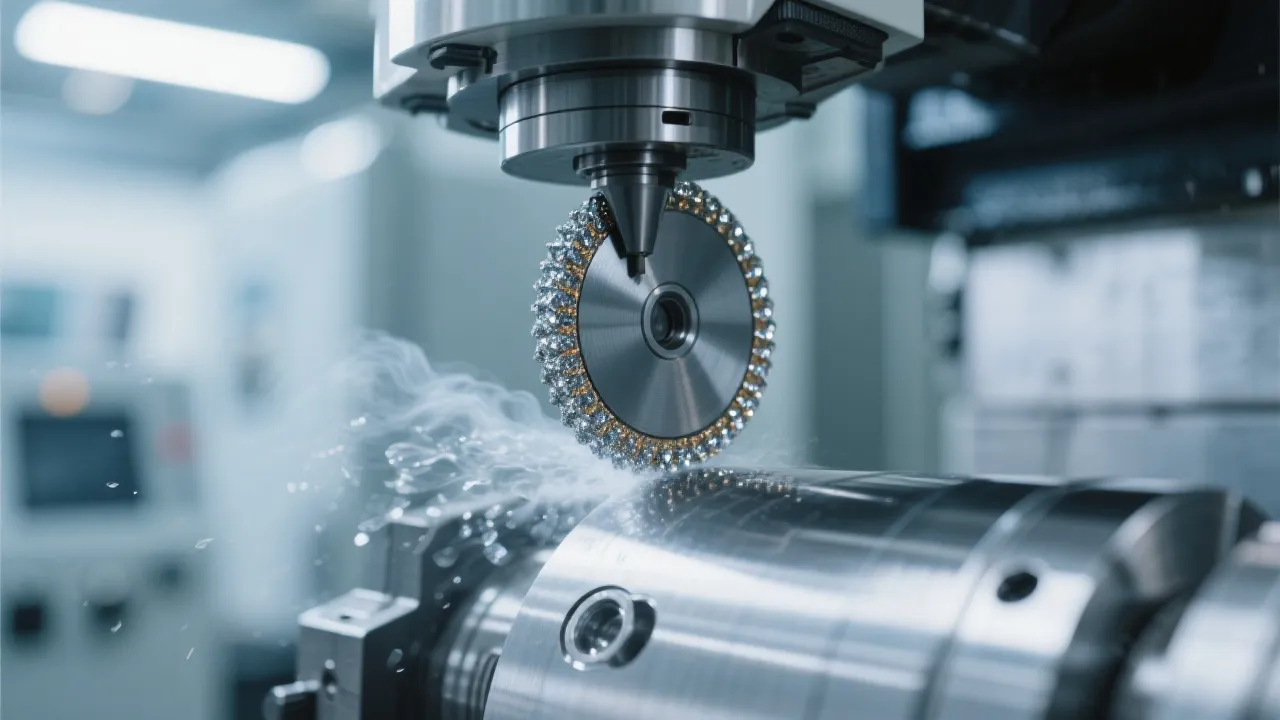
In the realm of precision manufacturing, curved surface precision grinding stands as a crucial process, especially in industries such as aerospace and mold making. Diamond grinding discs are widely used due to their superior hardness and wear - resistance. However, understanding their force characteristics and wear mechanisms is essential for achieving high - quality grinding results.
One of the significant differences between planar and curved surface grinding is the contact arc length. In curved surface grinding, the contact arc length can vary significantly. For example, when grinding an aerospace titanium alloy impeller, the contact arc length may increase by up to 30% compared to planar grinding. This increase in contact arc length leads to higher grinding forces.
The cutting angle also plays a vital role. In curved surface grinding, the cutting angle is in a state of dynamic adjustment. Unlike planar grinding where the cutting angle remains relatively stable, in curved grinding, the cutting angle can change by as much as 15 - 20 degrees during the grinding process. This dynamic change affects the chip formation and the force distribution on the grinding disc.
The wear of diamond grinding discs in curved surface grinding is mainly caused by mechanical wear and thermal wear. Mechanical wear occurs due to the friction between the grinding disc and the workpiece. The dynamic cutting angle and changing contact arc length can lead to uneven mechanical wear. For instance, in the grinding of stainless - steel mold cavities, the outer edge of the grinding disc may experience more significant wear due to the larger cutting forces at the outer part of the curve.
Thermal wear is another major factor. Local burn and uneven wear are often the results of poor heat dissipation. In curved surface grinding, the heat dissipation path is more complex compared to planar grinding. The heat generated during grinding can cause the diamond particles on the grinding disc to lose their sharpness or even fall off. In some cases, the temperature at the grinding zone can reach up to 800 - 1000°C, which accelerates the wear of the grinding disc.
To reduce local burn and uneven wear, optimizing process parameters is crucial. Different rotational speeds and feed methods can have a significant impact on the grinding results. For example, a lower rotational speed (around 2000 - 3000 rpm) combined with a step - by - step feed method can effectively reduce the grinding forces and improve heat dissipation.
| Process Parameter | Optimal Value | Effect |
|---|---|---|
| Rotational Speed | 2000 - 3000 rpm | Reduces grinding forces and improves heat dissipation |
| Feed Method | Step - by - step | Evenly distributes the grinding forces and reduces uneven wear |
In the aerospace industry, when grinding titanium alloy impellers, by optimizing the process parameters, the local burn rate can be reduced from 15% to less than 5%, and the uneven wear rate can be reduced by 20 - 30%. In the mold - making industry, for stainless - steel mold cavities, the optimization of process parameters has led to an increase in the grinding disc's service life by up to 40%.
Click to learn how to match the optimal grinding disc design according to the material type. Explore More
.png?x-oss-process=image/resize,h_800,m_lfit/format,webp)

 Grinding equipment maintenance
Grinding wheel balance adjustment
Grinding fluid management skills
Industrial grinding safety operation
Diamond grinding wheel usage guide
Automation diamond saw blades
Vacuum brazing technology
Metal cutting tools
Production efficiency improvement
Cutting equipment durability
brazed diamond grinding discs
carbide grinding
ultra - hard diamond
wear - resistant grinding tools
high - efficiency grinding tools
Brazed diamond grinding wheels
Diamond grinding wheel customization
Gray cast iron grinding tools
Industrial grinding wheel solutions
Super - hard material tools
brazed diamond grinding wheels
complex surface grinding
diamond wheel optimization
industrial grinding solutions
grinding process improvement
Grinding equipment maintenance
Grinding wheel balance adjustment
Grinding fluid management skills
Industrial grinding safety operation
Diamond grinding wheel usage guide
Automation diamond saw blades
Vacuum brazing technology
Metal cutting tools
Production efficiency improvement
Cutting equipment durability
brazed diamond grinding discs
carbide grinding
ultra - hard diamond
wear - resistant grinding tools
high - efficiency grinding tools
Brazed diamond grinding wheels
Diamond grinding wheel customization
Gray cast iron grinding tools
Industrial grinding wheel solutions
Super - hard material tools
brazed diamond grinding wheels
complex surface grinding
diamond wheel optimization
industrial grinding solutions
grinding process improvement



.png?x-oss-process=image/resize,h_100,m_lfit/format,webp)
.png?x-oss-process=image/resize,h_100,m_lfit/format,webp)
.png?x-oss-process=image/resize,h_100,m_lfit/format,webp)
.png?x-oss-process=image/resize,m_fill,h_800,w_800/format,webp)