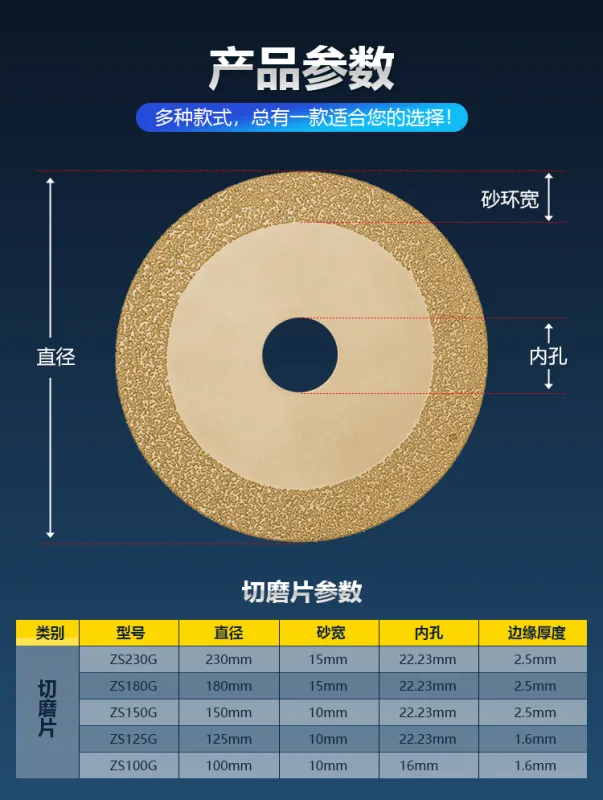
In high-speed industrial grinding applications—especially for brittle materials like granite, ceramic tiles, and engineered stone—the mechanical integrity of diamond grinding wheels is critical. A single wheel failure can cause production downtime, safety hazards, and costly rework. This guide explores proven engineering strategies that significantly improve impact resistance, drawing from real-world test data and case studies.
Three core parameters determine a grinding wheel’s ability to withstand dynamic loads:
A recent field study involving over 500 diamond wheels used in tile manufacturing revealed that 67% of premature failures were linked to poor thermal fatigue resistance—not just material quality. In one instance, a batch of wheels fractured within 4 hours of operation due to inconsistent heat dissipation caused by suboptimal segment geometry. Post-mortem analysis confirmed microcracks forming at the interface between the steel core and brazed layer—a clear sign of inadequate structural design.
To reduce such risks, engineers must adopt a dual approach:
Proper maintenance and process tuning also play a vital role. Regular inspection of wheel runout (< 0.05 mm), optimal coolant flow rate (≥ 15 L/min), and consistent spindle speed control (±5%) have been shown to extend wheel life by up to 30% in production environments.
For manufacturers investing in precision grinding automation, choosing a solution built on verified performance metrics—not just marketing claims—is essential. At Henan Yode Superhard Tools Co., Ltd., we combine rigorous lab validation with field-tested durability to deliver wheels that meet or exceed ISO 3697 standards for impact resistance.
Explore our premium brazed diamond grinding wheels designed for maximum impact resistance and long-term reliability. Get technical specs, application guides, and free samples today.
Discover Our Impact-Resistant Solutions
.png?x-oss-process=image/resize,h_800,m_lfit/format,webp)

 Automation diamond saw blades
Vacuum brazing technology
Metal cutting tools
Production efficiency improvement
Cutting equipment durability
grinder disc balance check
diamond grinding disc inspection
brazed diamond disc maintenance
industrial grinder safety
heavy-duty grinding tools
brazed diamond grinding wheels
complex surface grinding
diamond wheel optimization
industrial grinding solutions
grinding process improvement
brazed diamond grinding disc
heavy-duty grinding efficiency
diamond tool longevity
stainless steel grinding solution
industrial grinding performance
brazed diamond grinding wheels
heavy-duty grinding efficiency
wear-resistant diamond tools
stainless steel grinding solutions
industrial grinding wheel lifespan enhancement
Automation diamond saw blades
Vacuum brazing technology
Metal cutting tools
Production efficiency improvement
Cutting equipment durability
grinder disc balance check
diamond grinding disc inspection
brazed diamond disc maintenance
industrial grinder safety
heavy-duty grinding tools
brazed diamond grinding wheels
complex surface grinding
diamond wheel optimization
industrial grinding solutions
grinding process improvement
brazed diamond grinding disc
heavy-duty grinding efficiency
diamond tool longevity
stainless steel grinding solution
industrial grinding performance
brazed diamond grinding wheels
heavy-duty grinding efficiency
wear-resistant diamond tools
stainless steel grinding solutions
industrial grinding wheel lifespan enhancement



.png?x-oss-process=image/resize,h_100,m_lfit/format,webp)
.png?x-oss-process=image/resize,h_100,m_lfit/format,webp)
.png?x-oss-process=image/resize,h_100,m_lfit/format,webp)
.png?x-oss-process=image/resize,h_800,m_lfit/format,webp)